- Home Page
- Compnay Profile
-
Our Products
- Oil Seeds for B2B Sourcing
- Processed Spices for B2B Sourcing
- Flour Products for B2B Sourcing
- Pulses for B2B Sourcing
- Cereal Products for B2B Sourcing
- Sweeteners for B2B Sourcing
- Condiments for B2B Sourcing
- Snacks for B2B Sourcing
- Beverage Products for B2B Sourcing
- Natural Products for B2B Sourcing
- Dairy Products for B2B Sourcing
- Cooking Oils for B2B Sourcing
- Herbal Products | Bulk & Wholesale Supply
- Kitchen And Dining Supplies for B2B Sourcing
- Blogs

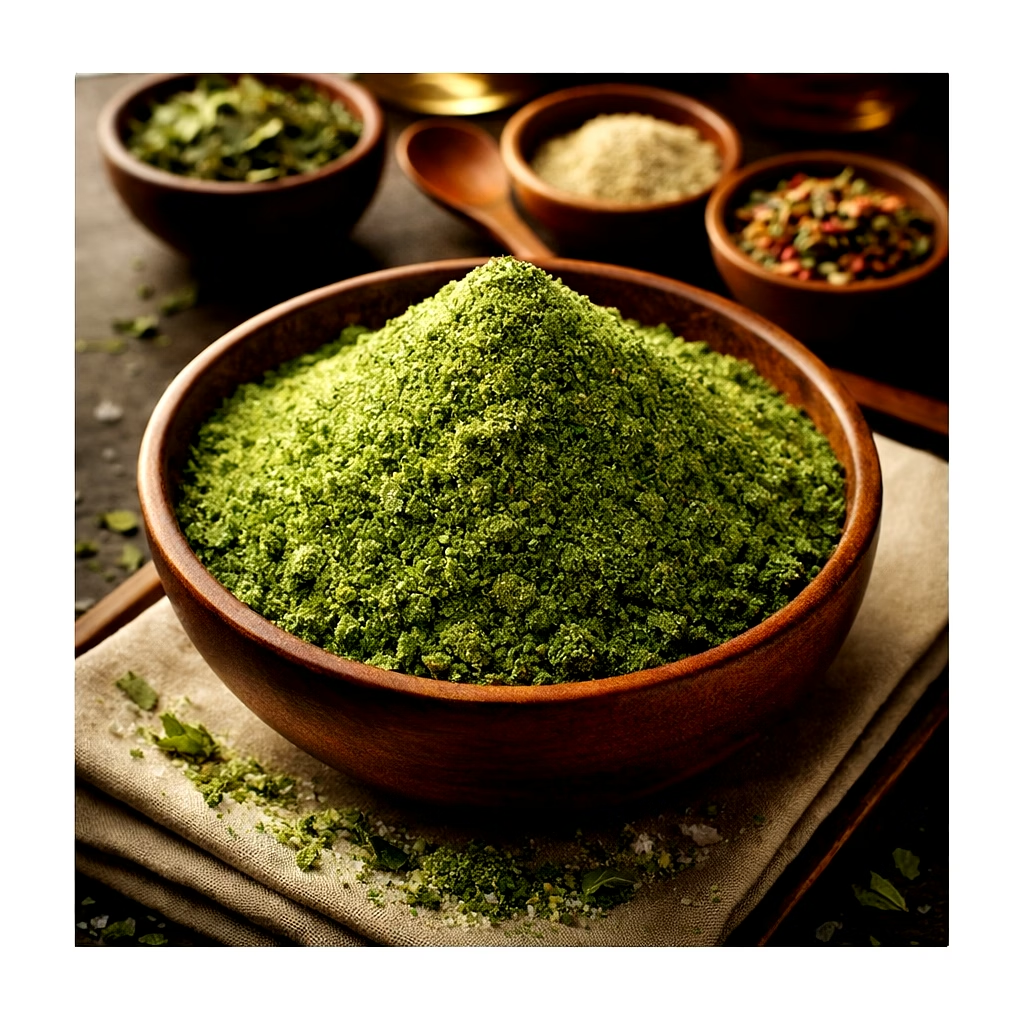
Herbal Powder - Bulk Wholesale Supply for importers, wholesalers & food brands for international buyers
-
Product is not available
Country Of Origin : India
Herbal Powder – Herbal Products Wholesale Export
Herbal Powder is a plant-based raw material processed under controlled agro-processing conditions to deliver consistent fine powder (custom mesh sizes) suitable for food, nutraceutical, and cosmetic manufacturing. Produced from India-sourced traceable herbs, it supports bulk supply programs aligned with Bulk Herbal Product Suppliers and Contract Herbal Goods Traders operating across regulated markets.
Designed for industrial herbal procurement, the powder format enables uniform blending, standardized dosing, and scalable formulation integration. Custom mesh calibration enhances dispersion behavior in encapsulation, beverage premixes, and topical bases. Structured for Herbal Powder bulk sourcing India and long term herbal distribution agreements, this format supports private labeling and contract manufacturing under export compliant herbal product shipments.
Key Features
- Controlled mesh sizing for predictable blending and dissolution behavior
- Traceable India-sourced botanical inputs with batch-level documentation
- Food and pharma-grade export packaging for regulated market entry
- Compatibility with OEM formulations and contract manufacturing models
- Structured bulk formats supporting global herbal distribution networks
Technical Attributes
- Fine Powder (custom mesh sizes) – Enables controlled particle dispersion and uniform formulation mixing
- Bulk supply configuration – Supports high-volume industrial procurement cycles
- Food/pharma-grade export packaging – Protects against moisture ingress and contamination during transit
- Single or multi-herb processing – Allows targeted or synergistic botanical formulation strategies
- Traceability documentation – Facilitates compliance review for international buyers
Herbal Powder Composition and Traceable Botanical Processing Structure
The structural integrity of this herbal powder depends on disciplined raw herb selection, controlled drying parameters, and calibrated micronization. Single herb variants preserve botanical identity for targeted functional applications, while multi-herb powders are processed to maintain proportional consistency across blended formulations. Each batch originates from India-sourced traceable cultivation zones, supporting documentation frameworks required in wholesale plant based herbal supply trade.
Particle size calibration through controlled milling determines surface area exposure, which directly influences extraction efficiency, suspension stability, and blending uniformity. Fine mesh customization allows manufacturers to align powder behavior with encapsulation machines, sachet fillers, and bulk blending systems. Moisture control during post-milling stabilization reduces agglomeration risk and supports shelf stability under varied climatic logistics conditions.
Processing environments are managed to align with food and pharmaceutical handling standards, ensuring suitability for cosmetic and nutraceutical conversion. Structured quality checks at sieving and packing stages reinforce consistency across large-scale consignments used in global herbal trading partnerships.
Functional Performance & Operational Efficiency
In manufacturing environments, the performance of herbal powder is defined by flow characteristics, dispersibility, and batch reproducibility. Fine mesh formats reduce sedimentation in beverage blends and improve homogeneity in tablet granulation workflows. Consistent particle distribution lowers segregation risk during bulk transport and automated feeding.
For OEM processors operating under Herbal Powder wholesale distribution models, predictable flow behavior supports uninterrupted production cycles and reduces recalibration downtime. Multi-herb combinations are engineered for uniform blending density, which improves dosing accuracy in capsule and sachet applications. Export packaging configurations provide barrier resistance against humidity fluctuations common in cross-border shipping corridors, preserving material integrity through extended transit cycles.
Application & Industry Deployment
Herbal powder serves as a foundational raw material for nutraceutical brands, Ayurvedic manufacturers, functional food producers, and cosmetic formulators. Industrial buyers leverage it for encapsulation, tea blends, health drink premixes, and topical powder bases. Structured supply programs enable herbal sourcing contracts for distributors and manufacturers requiring scalable volumes.
As part of bulk herbal products exporters worldwide networks, supply formats are configured for container-level dispatch aligned with global compliance documentation. The product integrates into herbal procurement partner for manufacturers frameworks where consistency, documentation clarity, and repeatable supply cycles are essential. Contract-based herbal goods supply models support private labeling initiatives and region-specific regulatory packaging adaptations.
Frequently Asked Questions
- Are single and multi-herb variants available? Yes, both formats are supplied based on formulation requirements.
- Can mesh size be customized? Custom mesh calibration is available for specific manufacturing processes.
- Is export documentation provided? Shipments include standard documentation for regulated international markets.
- What packaging formats are offered? Bulk food/pharma-grade packaging suitable for container export is available.
- Do you support private labeling? Contract manufacturing and private labeling programs are supported.
- Is batch traceability maintained? Yes, sourcing and processing records are maintained per batch.